
Collingsworth County Release Meanings
A person can leave the Collingsworth County Jail in several ways, and not all of them mean freedom in the community. Bond, personal recognizance, completion of a county sentence, or a court order may end physical confinement if no other hold applies. A transfer sends the person to another custodian. That receiving custodian might be TDCJ, another county, the United States Marshals Service, or immigration authorities. The sheriff's release entry should be read with its reason or destination. A name that simply vanishes from a current roster proves only that the person is no longer shown there.
Release and discharge are also different. Release often describes leaving a jail or prison building. Discharge usually means the sentence and any related supervision have ended. Parole and mandatory supervision place a person outside prison while TDCJ still supervises the sentence. Probation follows a court order and is handled through community supervision, not the county jail. The source must match the fact being checked: the sheriff for a local exit, TDCJ for a state-prison event, the court for the case result, and the proper federal agency for federal or immigration custody.
- Release
- An exit from one custodian, which may be to the community or another agency.
- Discharge
- The end of the sentence and supervision for the matter shown.
- Time served
- Credit or completion of the custodial part of a sentence.
- Detainer
- A request or authority that can cause transfer or continued custody after one jail matter ends.
Collingsworth County Release Types
The coded release type is as important as the date. It tells the reader whether the sheriff recorded a community exit, a transfer, or the end of one local hold. Bond does not dismiss a charge. Likewise, a court dismissal does not supply the exact minute jail staff completed release processing. Reading the exit code with the destination prevents a county departure from being mistaken for the end of all custody.
| Recorded event | Meaning | Next record to check |
|---|---|---|
| Bond or recognizance | Pretrial detention ended subject to conditions and other holds | Sheriff release entry and court bond order |
| Time served or sentence complete | Custodial time was credited or completed | Release entry, judgment, and any supervision order |
| Parole or mandatory supervision | State imprisonment ended, but TDCJ supervision continues | TDCJ and Parole Division records |
| Transfer | One custodian handed the person to another | Destination agency locator or records office |
| Dismissal or court-ordered release | The court changed the legal basis for custody | Court docket plus actual sheriff exit record |
| Death | Custody ended without community release | Official agency record; never describe as return to the community |
A separate warrant, detainer, or case may keep a person confined after one charge is resolved. For that reason, no single bond order or docket note should be treated as proof of physical release. The best record ties one booking number to an admission, an exact exit, and the recorded outcome or destination.
Collingsworth County Release Record Fields
A focused sheriff request should identify one person and one custody episode. The useful identifiers are the full name, date of birth if lawfully known, an approximate booking date, and a booking or cause number when available. The following inventory describes fields worth requesting from the jail-management record. It does not claim every item is public, stored in one screen, or available without redaction.
| Field | What it establishes |
|---|---|
| Booking number | Connects the admission and exit to one custody episode |
| Booking date and time | When county custody began |
| Arresting agency | Which agency initiated the booking |
| Charge and cause number | Links jail data to the correct court file |
| Bond and disposition fields | Shows recorded conditions or case-related action |
| Release date and time | When the sheriff's physical custody ended |
| Release type or destination | Distinguishes a community exit from a transfer |
| Booking photograph | Photo associated with that admission, subject to lawful limits |
The record may omit, redact, or withhold protected identifiers, medical data, security-sensitive facts, juvenile information, or material covered by another exception. Sealed and expunged matters require special care. A booking record is also not a finding of guilt. The court file supplies the complaint or indictment, orders, judgment, sentence, dismissal, and jail-credit notation when those items exist and remain public.
Keep the booking number at the center of the comparison. Common names, aliases, and close birth dates can produce a false match when a jail entry, court case, and state record are read apart. The cause number connects the release entry to the right court matter, while the booking number separates one stay from an earlier or later arrest. When a response contains several episodes, ask the sheriff which exit belongs to the requested admission rather than assuming the newest date answers the question.
Request Collingsworth County Release Records
The sheriff page does not provide an online public-information form or a release archive. Texas public-information guidance allows a written request for an existing record and stresses that the governmental body does not have to answer questions, perform legal research, or create a new document. A narrow request is easier to route and less likely to mix people with similar names.
- Address the request to the Collingsworth County Sheriff's Office and state that an existing booking-and-release record is sought.
- Give the full name, known date of birth, approximate booking dates, and booking or cause number if known.
- Ask for the release date and time, release type or destination, booking number, listed charges, disposition fields, and booking photo for that episode.
- Request electronic copies when available and ask for a cost estimate before work that will create a charge.
- Keep the response, any redaction explanation, and the exact wording of the request together.
The Texas Attorney General's request instructions explain written requests, prompt production, and the existing-record rule. The state charge guidance explains allowable cost rules, but the research found no local posted fee for this jail record. Do not reuse the county clerk's fee for recording official public records. That is not a stated criminal-case copy fee.
Ask for the existing record, not an explanation of what happened. A precise date range and booking identifier can reduce delay and mistaken identity.
Collingsworth Release Record Limits
Texas Government Code chapter 552 governs requests to governmental bodies for existing public information. The law permits exceptions and redactions. It does not make every item in a jail file public. Judicial records follow the rules of the court system instead of the Texas Public Information Act, so a sheriff request and a clerk request should remain separate.
Code of Criminal Procedure chapter 55A controls expunction procedure and its effects. Eligibility depends on the facts and legal requirements; release alone does not qualify a case. A final expunction can restrict covered release, maintenance, dissemination, or use and may explain why an old official record is no longer available. Nondisclosure under Government Code chapter 411 is different. It limits public disclosure while preserving access for recipients authorized by law.
No official web retention period was found for a Collingsworth County release list because the sheriff does not publish such a list. Request the dated custody episode itself. That approach is more reliable than assuming an old entry should remain on a live roster.
Collingsworth Release Court Records
Collingsworth County publishes the same clerk, Jackie Johnson, for its county-clerk and district-clerk pages, at the same Wellington contact point. That makes the first inquiry simpler, but it does not merge the courts. Felony and district matters must still be distinguished from county-level misdemeanor matters. The court with jurisdiction owns the judicial file.
The District Clerk page routes district cases, while the County Clerk page covers the county office. A judgment, dismissal, sentence, bond order, or jail-credit entry explains what the judge ordered. Pair it with the sheriff's release record for the actual exit time and destination. The re:SearchTX portal may help locate participating-court records, but access and document coverage vary.
The county clerk page lists a recording fee for official public records, not a criminal-case-copy price. A current estimate for copies or certification should come from the clerk. Repeating the unrelated recording amount would create a false local fee.
Judicial records and sheriff records can also update on different schedules. A signed order may appear before release processing ends, and a jail exit may occur before a scanned court document becomes easy to retrieve. Note the date and source of each item. If they seem to conflict, ask the office that created the specific field instead of treating one system as a correction service for the other.
Find Collingsworth County Released Inmates
There is no official county-hosted roster, 24-hour list, or 72-hour release archive documented in the research. Start by deciding who likely held the person. Local booking calls for the sheriff. A state sentence calls for TDCJ. A federal prison term calls for BOP. An immigration transfer calls for ICE. Then use a dated record rather than roster absence.
- Check the official sheriff page for current contact and notification links.
- Ask the jail whether the person remains physically held and, if not, what release date, type, or transfer destination staff can disclose.
- Check IVSS-Counties only after confirming Collingsworth appears as a participating county; the old county VINELink link is not proof of current coverage.
- Search TDCJ if the person may have entered state prison, and read projected dates as forecasts rather than completed releases.
- Check the correct court file for bond, sentence, dismissal, or jail-credit orders.
- Use BOP or ICE only when federal or immigration custody is genuinely at issue.
- Request the sheriff's booking-and-release record when documentary proof is needed.
A released person usually drops off a live jail roster. Disappearance can also mean transfer, correction, or another hold, so it is not proof of community release.
TDCJ Collingsworth Release Search
The TDCJ Online Inmate Search covers people in the state system. It is not a Collingsworth County Jail archive. County of conviction and place of confinement are different. A person sentenced in Collingsworth County may be held at a TDCJ unit elsewhere, since no state prison was identified inside the county.
| Search input or result | How to use it |
|---|---|
| Last and first name | Start a broad identity search and compare other fields carefully |
| TDCJ number | Use the state identifier when known for a more exact match |
| SID number | Use the Texas state identification number when lawfully known |
| County and court of conviction | Confirm the record relates to the Collingsworth case |
| Current location | Shows present state custody information when applicable |
| Projected release date | A forward-looking estimate, not proof of exit |
| Incarceration history | Request through TDCJ channels to confirm past state events |
The TDCJ email information channel can provide listed incarceration and projected-date information when the required identifiers are supplied. For a past exit, ask for incarceration history and the actual release or discharge event. If the person is on parole or mandatory supervision, the state still has a supervision role.
The TDCJ search form below is shown as a blank official search, not as proof about a named person. The surrounding result must always be matched to identity and custody type.
Open the official TDCJ search form.
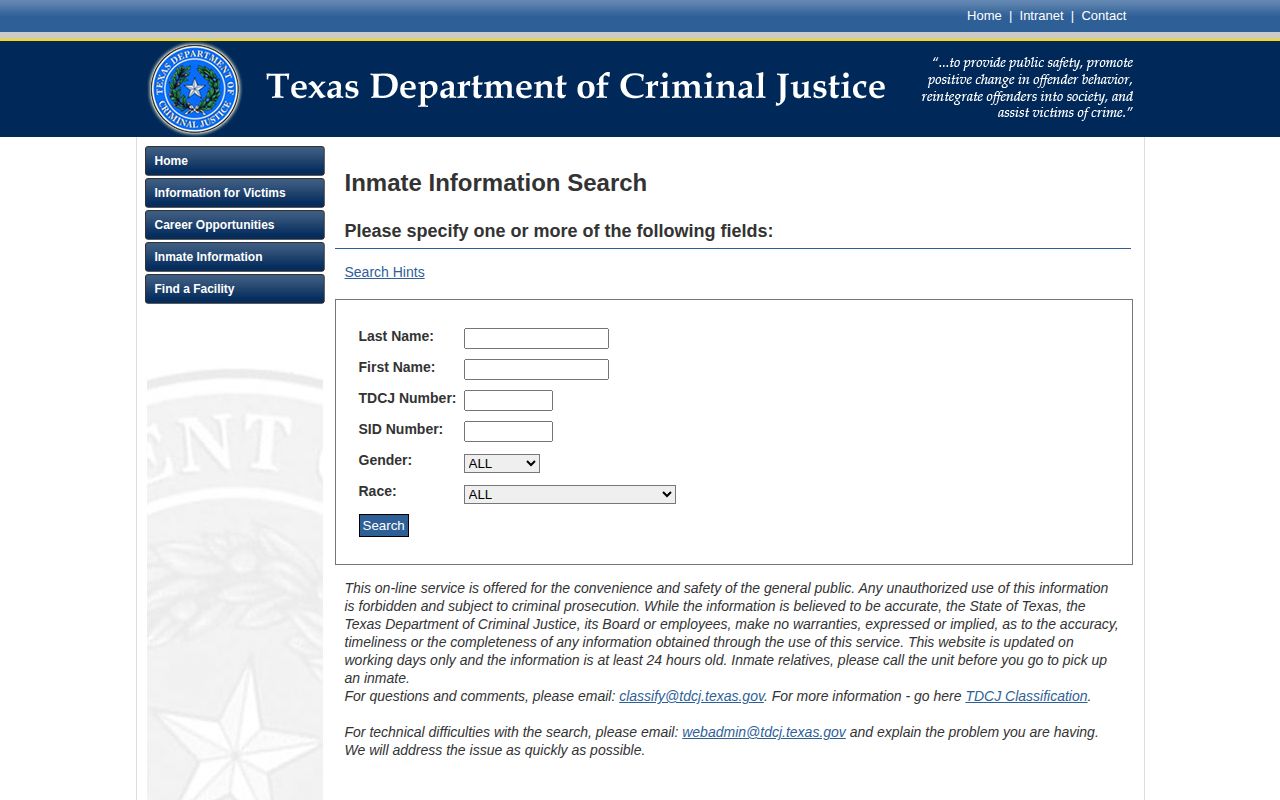
The form supports the state-prison path; it cannot confirm a local jail release that never entered TDCJ.
Result language matters. A maximum sentence date marks the end of the sentence as calculated in the state record, while a projected release date estimates a possible release under current information. Parole review or approval does not show that the person has left a unit. Release-plan review, detainers, required documents, and later record changes can still affect the event. For an actual past release, seek the incarceration-history entry that records what occurred.
Collingsworth Recent Release Records
The sheriff's official page has no visible current roster or recent-release feed. It also gives no publication cadence, photo field, or online retention period. Claims on commercial pages about a free local release database are not supported by the county source. For someone believed released today, call the jail, check current IVSS-Counties participation, and make a narrow fixed-range request.
The request can seek all existing release entries in a defined 24-hour or 72-hour span, with release time, type, destination, booking number, and charges to the extent those fields exist and are public. Ask for a cost estimate. A person-specific request is better when only one release matters. The separate 24-Hour Release List page explains this local fallback without pretending a feed exists.
Collingsworth Release Notification Paths
The county sheriff page still sends users to legacy VINELink. Texas now directs county notification users to IVSS-Counties, and the Attorney General warns that not every county participates. Confirm that Collingsworth is selectable before relying on the service. For a person in state prison or on state parole, use the separate TDCJ IVSS portal. Notifications are alerts, not substitutes for the agency's release record.
Federal custody has two other routes. The BOP Inmate Locator includes federal prisoners from 1982 onward and may show a release date or Released status. It does not cover ordinary Collingsworth jail stays. The ICE Online Detainee Locator helps locate qualifying people believed transferred to immigration custody, but it is not a historical county release archive. The U.S. Marshals Service has no comparable general public history search for released pretrial prisoners.
Collingsworth Custody Versus Release
Choose the record by both custodian and time. A live locator answers where someone may be held now. A release record answers how and when one custodian's control ended. A court file explains the legal order. None should be made to prove a fact it was not designed to show.
| Situation | Best first source | Main limit |
|---|---|---|
| Currently held in county jail | Direct jail confirmation | No official public roster was found |
| Released from county jail | Sheriff booking-and-release record | Must read type or destination |
| In or released from state prison | TDCJ search and incarceration history | Projected date is not actual release |
| Court outcome | Clerk for the court with jurisdiction | Order may not show exact jail exit time |
| Federal prison history | BOP locator | Does not cover county detention |
| Immigration custody | ICE locator and contact fallback | Not a historical county release list |
Collingsworth County Release Facility
The Collingsworth County Jail is the only local adult county detention facility identified in the facility research. It is operated by the sheriff. A local exit is documented in the sheriff's booking-and-release record, while transfer to TDCJ or a federal agency sends the search to that receiving system. No TDCJ prison, BOP institution, or ICE-owned detention center was identified within Collingsworth County.
That finding does not rule out temporary contract beds or a past transfer. It means those statewide and federal systems are search routes, not local facility pages. Always confirm the destination stated on the county release record.