
Collingsworth Parole and Probation
Parole is a conditional release from a Texas Department of Criminal Justice prison before the sentence fully ends. The Texas Board of Pardons and Paroles makes the release decision, while the TDCJ Parole Division supervises the person afterward. Mandatory supervision is another state release mechanism. It is discretionary for many modern offenses and unavailable for offenses listed by law. Both statuses mean the person has left a prison unit but has not necessarily reached full discharge.
Probation, called community supervision in Texas law and agency records, begins with a court order. It may be imposed instead of prison, after a jail term, or as part of a sentence structure. It is administered through the local Community Supervision and Corrections Department, not by the county jail. A Collingsworth County jail release does not prove either status. The signed court order, TDCJ record, and assigned supervision office provide the answer.
| Feature | Parole or mandatory supervision | Probation |
|---|---|---|
| Starting point | Release from TDCJ physical custody | Order from the sentencing court |
| Decision source | Texas Board of Pardons and Paroles and applicable law | Judge and court record |
| Supervising agency | TDCJ Parole Division | Local Community Supervision and Corrections Department |
| Best verification | TDCJ status, release data, and assigned parole office | Judgment, docket, and local supervision office |
| End point | Discharge or other recorded end of state supervision | Court-ordered completion or discharge |
- Parole
- Conditional release from prison before the sentence discharges.
- Probation
- Court-ordered community supervision, often imposed without a prison release.
- Discharge
- The recorded end of a sentence or supervision term.
- Absconder
- A person alleged to have stopped reporting or left supervision without permission.
Verify Collingsworth Post-Release Supervision
Begin with the last confirmed custodian. Someone who left the Collingsworth County Jail may have gone home, transferred to TDCJ, or moved into another agency's custody. Someone released from a TDCJ unit may be on parole or mandatory supervision. A probationer may never have served a state-prison term at all. That custody history decides which record to search.
- Identify the case and custody path. Use the full name, date of birth when lawfully known, cause number, TDCJ number, or SID number to avoid a same-name error.
- Check TDCJ for state supervision. Use the official TDCJ inmate search and offender-information channels. Compare status, release date, next review, and maximum sentence information.
- Confirm parole with the assigned office. Use the official county-to-office mapping and the office shown in the person's state record. Do not assume the nearest office holds the file.
- Confirm probation from the court. Obtain the judgment or supervision order, then contact the combined local supervision department for information it may lawfully disclose.
- Separate approval from release. A favorable vote can come before release-plan review, certificate processing, and physical departure.
- Ask for a record when needed. Seek the specific state release or discharge record, or the identified court order, instead of relying on a missing search result.
TDCJ's online search is designed for people currently incarcerated in a state facility. A person who no longer appears may need an incarceration-history request or Parole Division check. The home page provides the broader Collingsworth County released-inmate search path when the last custodian is uncertain.
Note: A future projected date or favorable parole vote does not establish that a person has physically left state custody.
Collingsworth Supervision Office Contacts
Collingsworth County state releases assigned to the Amarillo district are served by the TDCJ Amarillo District Parole Office. The official TDCJ county-to-office list maps Collingsworth to that office. Confirm the assignment from the person's record because supervision placement can depend on the approved residence plan rather than the county of conviction alone.
TDCJ Amarillo District Parole Office
5809 South Western Street, Suite 120
Amarillo, TX 79110
Phone: 806-355-9218
Fax: 806-353-9572
Local probation is handled through the combined Carson, Childress, Collingsworth, Donley and Hall County Community Supervision and Corrections Department. Texas does not publish a general probationer search comparable to its current-inmate tool. The sentencing case remains the key source for whether community supervision was ordered and for its term.
Community Supervision Main Office
101 Avenue F NW
Childress, TX 79201
Phone: 940-937-3671
Fax: 940-937-3786
Collingsworth Probation Is Not Parole
The Collingsworth County website lists probation apart from sheriff and court functions. Texas places parole within TDCJ. That local navigation reflects a real legal split. A probationer is not necessarily a released TDCJ prisoner, and a parolee is not supervised by the Collingsworth County Jail. This distinction is the county's most useful routing rule.
For probation, start with the sentencing judgment and local supervision office. For parole or mandatory supervision, start with TDCJ, the Board result, and the assigned district parole office. If the Collingsworth jail record says only that a person was transferred, trace the receiving agency before calling the event a community release.
Note: County of conviction, release county, and the place where a person reports after release may be three different locations.
Collingsworth Parole Review Records
Texas parole review is usually an administrative file review, not a public courtroom hearing for each person. TDCJ identifies a case before the review point. An institutional parole officer prepares a summary, notice goes to authorized participants, and a three-member panel votes in sequence. Two matching votes decide the case. An interview with the person is discretionary.
The official BPP review process explains this sequence. Approval codes may include FI, meaning further investigation and release processing. Denial results include NR, which sets a later review, and SA, or serve all. Program conditions can also appear. Read the exact official code. An approval remains subject to eligibility checks, release-plan work, special conditions, and certificate processing.
The official parole-office mapping can be viewed at its TDCJ source.
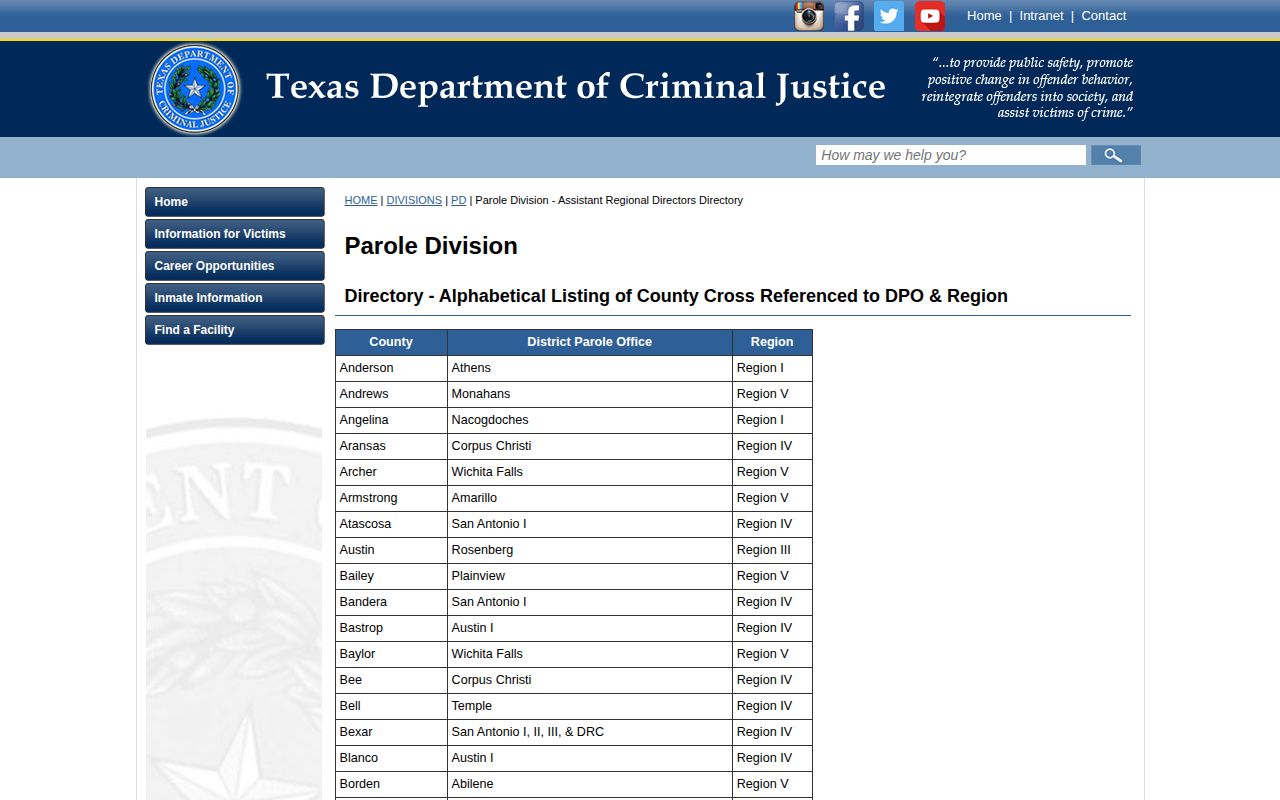
The image is a routing reference, not proof that any named person is currently supervised by the Amarillo office.
Collingsworth Supervision Violations
Conditions vary by case. They can address reporting, travel, treatment, fees, contact, residence, or other conduct stated in the release certificate or court order. The official document controls. A general web summary cannot establish one person's conditions, and a parole approval code does not reveal every rule that will apply after release.
An alleged violation can lead to investigation, a warrant, revocation proceedings, or a return to custody. An absconder status means supervision authorities allege the person stopped complying with reporting or location rules. It does not erase the earlier release. No official Collingsworth online absconder list was found. Verify a warrant through the issuing agency or court, and do not approach a person believed to be wanted.
Collingsworth Supervision Status Channels
No single public screen answers every post-release question. TDCJ's current-inmate form can help trace a state case before release, but it is not a lasting archive for people who have left a prison unit. The offender-information email route can provide incarceration history and other listed facts. Send the full name and seven-digit TDCJ number when known. If it is not known, TDCJ accepts the exact date of birth or an approximate age with county of conviction. Put the person's name in the subject line. TDCJ states that this basic information service has no charge.
For probation, Texas has no equivalent public statewide person search. The Collingsworth sentencing docket and judgment show whether the court imposed community supervision, its term, and later public revocation or completion events. The combined supervision department can confirm reporting information it is allowed to disclose. The sheriff's release entry answers only when and how county custody ended. It does not establish that probation remained active afterward.
The Texas DPS Sex Offender Registry is another distinct system. It applies only when a person has an independent legal duty to register. A match is not a general parole record, and no match says nothing conclusive about prior custody or ordinary supervision.
Note: Use each database only for the agency and legal status it was built to report.
Collingsworth Supervision and Discharge
Physical release and discharge are different events. A parolee or mandatory-supervision releasee has left a prison unit but remains under TDCJ supervision. Full discharge means the relevant sentence and supervision have ended. A probation term ends through the court and local supervision process shown in the case record. Completion should be verified from the agency or court that owns the status.
Government Code chapter 508 supplies much of the Texas parole and mandatory-supervision framework. Eligibility depends on the offense date, offense type, sentence, consecutive terms, findings, credits, and other law. Avoid a fixed percentage claim. Eligibility opens review but does not promise release. If exact end status matters, ask TDCJ for incarceration history and discharge information or obtain the court's completion order for probation.
Release processing can include review of a proposed residence, legal eligibility, special conditions, and other prerequisites before TDCJ issues a release certificate. Those steps explain why a Board decision and the jail-door event may fall on different days. Later, supervision can end by ordinary discharge, but a new case, warrant, or revocation can change the path. Quote the final state or court record rather than inferring completion from the passage of time.
Note: A registry duty, another case, or another agency's hold may continue even after one supervision term ends.