
Collingsworth Projected Release Meaning
Texas uses several dates that sound alike but prove different facts. The Texas Department of Criminal Justice, or TDCJ, defines a Projected Release Date as the date its Classification and Records Office calculates for a person to leave incarceration if parole does not occur sooner. It is an estimate based on the sentence and the rules that apply to that case. Maximum Sentence Date is the end point of the sentence calculation. Parole eligibility is merely the first point at which parole may be considered. None of these fields, standing alone, proves that a person walked out.
A Scheduled Release Date can appear after approval and an audit. TDCJ may also show a Scheduled Release Location. Those are operational fields, yet TDCJ warns that a scheduled date can change without notice. Staff still must audit the release certificate, check the release plan, and clear any legal barrier. Actual release is the completed exit recorded by the custodian. Discharge has a narrower meaning: the relevant sentence and supervision have ended.
A pretrial detainee has no sentence-based projected date. Bond action, dismissal, a plea, a court order, or transfer may end the stay, but the time is not known until the required event and jail processing occur. A signed order may still be followed by hold checks and paperwork.
Find Collingsworth Projected Release Dates
Start with the last custodian. A person sentenced to a Texas prison is searched through TDCJ. Someone serving a local term at Collingsworth County Jail requires the sheriff's booking and release entry plus the sentencing court's papers. A federal sentence belongs to the Bureau of Prisons, while an immigration hold belongs to ICE. County geography does not make the county jail the source for every case.
- Confirm custody. Ask whether the person is held at Collingsworth County Jail, a TDCJ unit, a federal facility, or another agency.
- Search current TDCJ custody. Use the official TDCJ inmate search for a state prisoner. A TDCJ or SID number is best; a name result must be checked against birth and conviction details.
- Read the exact label. Note Projected Release Date, Maximum Sentence Date, parole fields, status, and location. Do not turn a future projection into a release claim.
- Use records channels. For incarceration history or a projected date not resolved online, follow the TDCJ offender-information email instructions. For a local sentence, request the judgment, jail-credit order, and sheriff release record.
- Confirm near the event. TDCJ data is at least a day old and updates on working days. Call 936-295-6371 or 800-535-0283 during posted weekday hours when timing is close.
The current TDCJ form accepts last name, first name, TDCJ number, SID number, gender, and race. Its minimum input is a last name with first initial, a TDCJ number, or a SID number. Last-name matching is exact. Search results cover people currently confined in TDCJ, not a complete archive of released people. A missing result is not proof of release.
The official TDCJ inmate-information page places the current search beside other records channels and cautions readers to use the proper service.
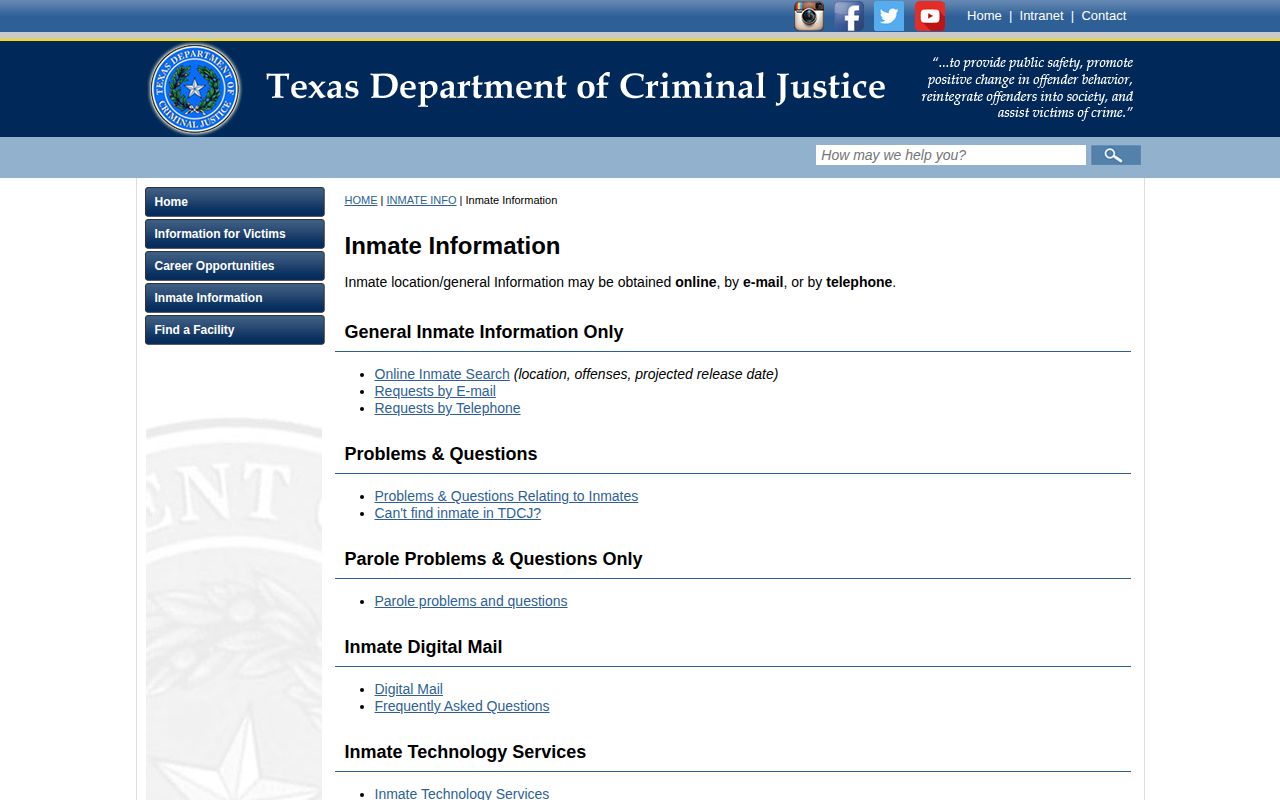
This source view is an entry point for a current state prisoner. It is not a screen showing that a named Collingsworth County person was released.
Check each result again when the expected release day draws near.
| Field or channel | What it can establish | Limit |
|---|---|---|
| Projected Release Date | TDCJ's current calculated exit date | Can change and is not an actual exit |
| Scheduled Release Date | Approved release moving through processing | May change before completion |
| Maximum Sentence Date | Calculated sentence end point | Parole may occur sooner |
| Incarceration history | Past state custody and release data | May require the TDCJ email channel |
| County release record | Actual local exit time and release type | Must come from the sheriff |
The Collingsworth County released-inmate search path explains how to trace an actual exit after a person has left a current-custody display.
Who Calculates Collingsworth Release Dates?
For a Collingsworth case that leads to state prison, the public projection comes from TDCJ, not from a county calculation. TDCJ Classification and Records applies the sentence, offense date, offense type, flat time, legally available good time, mandatory-supervision rules, and action by the Board of Pardons and Paroles. Its official definitions explain the difference between the projected date and maximum sentence date.
A sentence served in Collingsworth County Jail follows a different record trail. Obtain the court judgment, the jail-credit entry, the booking date, and the sheriff's actual release entry. A TDCJ field does not govern that local stay. Nor should a reader do simple calendar math and promise an exit day. Another case, hold, amended order, or jail processing step may control the result.
This split is the county's key release-date quirk. The same criminal case can begin in local custody and later move to TDCJ. Once transferred, the state system owns the prison calculation. If the sheriff confirms that the person left its custody for TDCJ, that event is a transfer, not a return to the community.
For court documents, the Collingsworth District Clerk is the record custodian for district cases. A docket or judgment can explain sentence length and jail credit, but the sheriff or TDCJ confirms physical release. Each source answers a separate question.
Texas Good Time Release Rules
Texas Government Code chapter 498 authorizes the TDCJ good-conduct-time system. Good time is a release-calculation and classification credit. It does not shorten the sentence pronounced by the court, and it does not create an unconditional right to leave prison. Credits can be earned, lost through discipline, or restored under the governing rules.
Texas does not have one universal rule that every prisoner serves exactly 85 percent. For some serious offenses, parole eligibility may require actual calendar time equal to one-half of the sentence or 30 years, whichever is less, without good time reducing that minimum. Other offenses and offense dates follow other rules. Sections 508.145 and 508.149 address parole eligibility and restrictions on mandatory supervision. The exact conviction and offense date matter.
- Flat time
- Actual calendar time spent in custody.
- Good time
- A statutory credit used in classification and certain release calculations.
- Mandatory supervision
- A statutory form of supervised release that may require board approval and is unavailable for listed offenses.
- Parole
- Discretionary supervised release before full sentence discharge.
- Discharge
- The point when the relevant sentence and supervision end.
For many cases with offenses after August 31, 1996, reaching the arithmetic point where calendar time plus applicable good time equals the sentence does not ensure release. The Board of Pardons and Paroles must approve discretionary mandatory supervision for an eligible case. A denial can move the projected date toward maximum expiration. Parole may occur sooner only after eligibility, a favorable vote, and completion of release processing.
Note: Good time can affect a calculation without changing the sentence imposed by the Collingsworth court or guaranteeing a release day.
Why Collingsworth Release Dates Change
A projection is recalculated when a fact used in the formula changes. Some changes are routine, such as newly earned credit. Others result from a court correction, discipline, a board decision, or a second case. The date should therefore be saved with the status and the date it was checked.
| Change | Effect on the date | Best confirmation |
|---|---|---|
| Good time earned, lost, or restored | May move the projected date | TDCJ Classification and Records |
| Jail credit or sentence correction | Changes time credited or the sentence basis | Court order and updated agency record |
| Consecutive sentence | May extend the combined calculation | Judgment and TDCJ calculation |
| Parole action | Approval may permit an earlier exit; denial does not | BPP result and TDCJ release status |
| Mandatory-supervision review | Denial may move projection to maximum expiration | BPP and TDCJ fields |
| Detainer or hold | May cause transfer or prevent community release | Holding agency and release record |
A detainer is a request by another authority to hold or transfer the person. It can turn the end of one custody term into another custodial move. Likewise, a favorable parole vote does not mean the person has left prison. TDCJ Review and Release Processing checks residence plans, legal eligibility, special conditions, and release documents before issuing the certificate.
The TDCJ review and release process shows why approval and physical release must stay separate. Telephone lines also distinguish stages: 844-512-0461 is listed for review status before a vote, while 512-406-5202 is listed for release status after a favorable vote.
Confirm Collingsworth Actual Release
Near a projected day, recheck the official record and contact the agency that has custody. For TDCJ, compare status, scheduled date, scheduled location, and release information. For Collingsworth County Jail, ask whether the person is physically in custody now and whether the existing record shows release, transfer, or another hold. Use the clerk's judgment to explain the sentence, not to invent a jail-door time.
A notification can give a timely lead. County notification in Texas has moved toward IVSS-Counties, though current Collingsworth participation must be checked in the live portal. TDCJ IVSS is a separate state-prison and parole notification system. Neither is a certified release record. The Collingsworth VINELink and IVSS check describes how to match the notification system to the custodian.
If the person no longer appears in the current-only TDCJ search, request incarceration history rather than assuming discharge. Parole or mandatory supervision means the person left prison but remains supervised. Discharged means the term has ended. A new facility means confinement continues. Use those exact labels when recording the result.
Note: Always confirm an important release with the custodian because a projected or scheduled date can change before the person exits.